
Here’s something I tell almost every new client. Chicago multifamily real estate has made more ordinary people wealthy than just about anything else in the Midwest. Not the flippers. Not the guys who timed the market. Regular folks who bought a building, collected rent, and let their tenants pay down the mortgage year after year.
A three-flat on the right block can pay its own bills. It can leave you a little extra every month. And ten years later it’s usually worth a lot more than you paid.
So it’s no surprise people keep coming back to it. Some want a two-flat where they can live upstairs and rent out the garden unit. Others are on building number five. Doesn’t really matter which one you are. The ones who do well know their numbers and know the neighborhoods, and that’s what this guide to Chicago multifamily real estate is about. We’ll cover the math, where to buy, and the financing a lot of people don’t even know they qualify for.
Why Investors Keep Choosing Multifamily
The pitch is pretty simple. More units, more rent checks.
If you own a single-family rental and the tenant moves out, your income from that house goes to zero. Overnight. Own a four-flat and lose one tenant? You’ve still got three people paying rent while you show the empty unit. That’s a very different month.
That cushion is a big reason Chicago multifamily real estate tends to hold up when the market cools off. People still need a place to live. Lots of them want to be near work, near the L, near their parents, and they’re not ready to buy. So well-run buildings stay pretty full even when house sales slow down.
The part people underestimate is the financing. Most lenders still treat a two- to four-unit building like a house, not a commercial property. Live in one of the units and you can usually get an owner-occupied loan. That means a down payment way smaller than the 25 percent most people assume they’ll need.
I can’t tell you how many investors in this city started exactly this way. Found a Chicago two flat for sale. Bought it. Lived in one half for a couple years while the tenant covered a good piece of the mortgage. Moved out, kept the building, bought the next one.
The Numbers Every Investor Should Understand
The price on the listing? It doesn’t tell you much.
I’ve seen $400,000 buildings that were a much better deal than $300,000 ones sitting a few blocks away. What matters is what the building earns and what it costs to keep running. Before you make an offer on any Chicago multifamily real estate, you want to be comfortable with a handful of numbers.
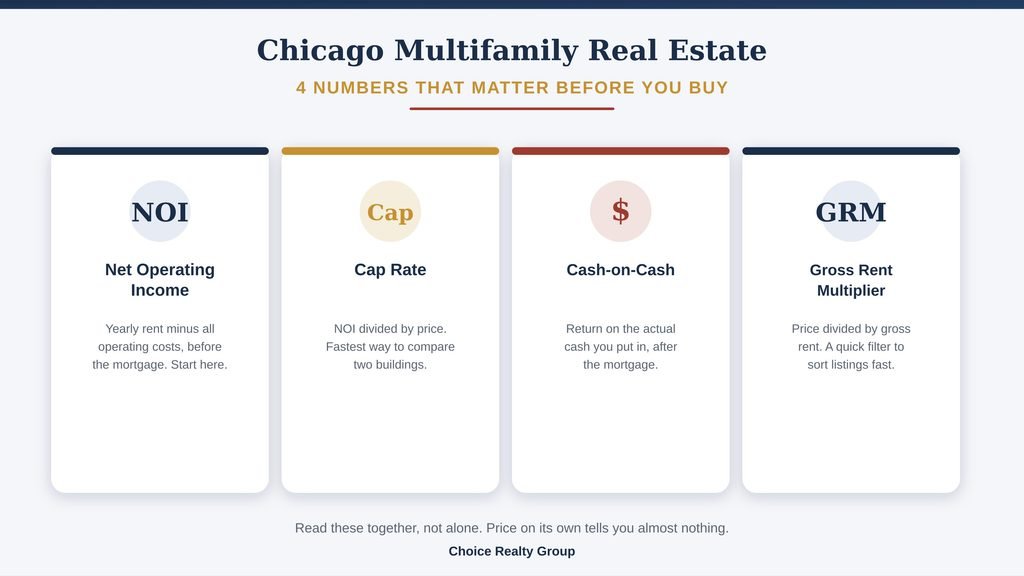
Net operating income (NOI). Start here. Add up a year of rent. Subtract every cost of running the place except the mortgage: taxes, insurance, water, repairs, management, plus some money set aside for vacancy. Whatever’s left is your NOI. We leave the mortgage out on purpose, because NOI is about the building, not your loan.
Cap rate. That’s NOI divided by price. A building doing $30,000 in NOI at a $500,000 price is a 6 percent cap. It’s the fastest way to compare two buildings side by side. One catch, though. Cap rates move from neighborhood to neighborhood, and a 5 percent cap on a quiet, steady block can honestly be safer than an 8 percent cap somewhere that’s struggling.
Cash-on-cash return. This is the one most investors care about, because it’s about your money. Let’s say you put $120,000 into the down payment and closing costs. After paying the mortgage, the building nets you $9,600 a year. That’s 8 percent cash-on-cash. Two buildings can have the exact same cap rate and totally different cash-on-cash returns, depending on how you finance them.
Gross rent multiplier (GRM). Quick and dirty. Price divided by a year of gross rent. It ignores expenses, so don’t lean on it too hard. But it’s great for scrolling through listings and tossing out the ones that are obviously overpriced.
Look at one of these alone and you can fool yourself. A cheap building with a weak cap rate and barely any cash flow isn’t a bargain. It’s a headache someone put a nice price on. You need to see all of them together.
Financing Chicago Multifamily Real Estate
When it comes to buying multifamily property Chicago first-timers usually trip over the money part. I watch people walk away from great opportunities here all the time. They hear “investment property,” figure they need a giant commercial down payment, and never even call a lender.
If it’s a two- to four-unit building and you’re going to live there, you’re in owner-occupied territory. FHA loans can go as low as 3.5 percent down on these buildings. On top of that, the rent from the other units can often count toward qualifying you. Conventional owner-occupied loans come in well under commercial down payments too. If you ask me, it’s the easiest door into Chicago multifamily investment, and it’s exactly why the two- to four-unit buildings get so competitive with first-time buyers.
Five units or more is a different story. Now you’re in commercial lending. Plan on 20 to 30 percent down. The bank cares less about your salary and more about the building’s income. They’ll look hard at something called the debt service coverage ratio, which is just the building’s NOI compared to its loan payments. Most lenders want the NOI to be at least 1.2 to 1.25 times the yearly debt. In plain English: the building needs to pay its own mortgage with some breathing room.
There’s also a DSCR loan, which was built for investors. The lender mostly looks at the property’s cash flow instead of your W-2. If you’re self-employed, or you already have a few mortgages, this can be what gets you to the closing table instead of stuck in underwriting.
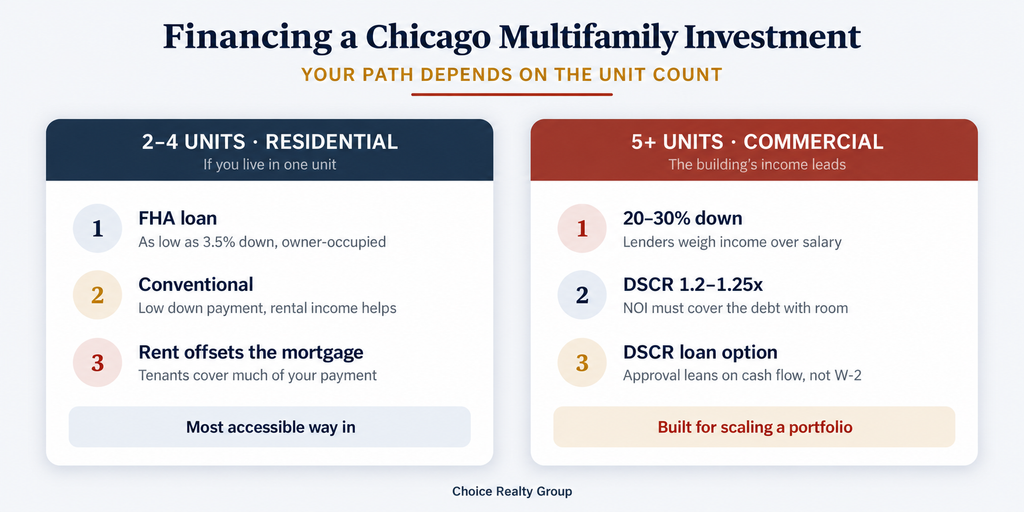
Bottom line on financing? Figure it out first. In Chicago multifamily investment, the loan shapes everything else. It decides which buildings even make sense for you. Someone who wants to house-hack a two-flat is looking at a completely different list than someone putting cash into a twelve-unit. Don’t fall in love with a building before you know how you’re paying for it.
Choosing the Right Property and Location
Two buildings on the same block can perform like they’re in different cities. That’s just how Chicago multifamily real estate works. So the building and the exact address matter as much as the price does.
Start with the unit mix, because the multifamily properties Chicago investors buy come in every shape you can think of. A building full of one-bedrooms is a different animal than one full of three-bedrooms. Different tenants, different rents. Bigger units tend to keep people longer, and that saves you a lot on turnover. Smaller units can bring in more rent per square foot.
Then condition. Old roof, tired boilers, knob-and-tube wiring. Any one of those can wipe out your first year of returns before rents ever have a chance to catch up.
And the tenants. Are the leases current and actually written down? Is everybody paying on time? Are rents at market, or did the current owner leave money on the table that you can slowly bring up?
Location in Chicago multifamily real estate isn’t really one decision. It’s a few, because every area plays by its own rules.
- Chicago proper has the deepest rental demand and the biggest mix of neighborhoods. You’ve got steady working-class blocks, and you’ve got areas on the way up where appreciation is the whole point.
- Cicero has been a reliable cash-flow market for a long time. Good rental demand, and prices that still make sense if monthly income is your goal.
- Evanston costs more. What you get back is stability and strong tenants, with the university nearby and an easy train ride downtown. It’s more of a long-term appreciation play than a cash-flow one.
- Calumet City and Chicago Heights come in at lower prices. That can mean better cap rates, as long as you understand the local demand and stay on top of management.
So which multifamily properties Chicago has are “right”? Depends on what you want out of it. Chasing cash flow takes you to different neighborhoods than chasing appreciation. A lot of experienced investors end up with some of each. And when you’re looking at the multifamily properties Chicago buyers are bidding on, the one that fits your plan is almost never the cheapest one on the list.
How to Analyze a Deal Before You Offer
The best buys I’ve seen in Chicago multifamily real estate all came from the same boring habit. Run the numbers the same careful way, every single time.
First, get the real rent roll. Not the “pro forma.” Not “potential rent.” Ask what every unit is paying right now and when each lease ends.
Second, get the real expenses. Ask for the last twelve months: property taxes (and in Cook County, look at those twice), insurance, any utilities the owner pays, water and sewer, trash, management. If the seller’s expense number looks low, it’s probably low for a reason. Then add money for repairs and for vacancy, even if every unit is full today. Over the years you own it, you’ll need both. Trust me.
Third, build your NOI from those real numbers. Run the cap rate. Run the cash-on-cash with your actual loan. Then decide what the building is worth to you. That number won’t always match the asking price, and that gap is exactly where a good buyer’s agent earns their money.
One more step people skip. Go walk the building. Read the leases yourself. A spreadsheet isn’t going to tell you the back porch is rotting, or that three tenants have a clause that lets them leave early. The paperwork and the building need to tell the same story before you trust either one.
Common Mistakes New Investors Make
I see the same handful of mistakes over and over with people new to Chicago multifamily real estate. Number one, by a mile: running the numbers on hope. Every unit full forever. Expenses that are way too low. Rents above what the market will pay. Then the building comes in short and everyone’s surprised. Use what the building actually does. Find the upside after that.
Number two is not reading the leases or checking on the tenants. Imagine closing and then finding out one tenant hasn’t paid in three months. Or that the rents are locked below market for the next two years. That’s all sitting in the documents. It just doesn’t help you unless you read them.
Then there’s getting fixated on price. The cheapest building on the market is rarely the best investment. Not once you count the deferred repairs, the weak rents, or a street that isn’t holding its value. Over the years, what the building earns matters way more than saving twenty grand at closing.
And going it alone on your first deal. That’s how people learn very expensive lessons. Buying multifamily property Chicago style means dealing with tenant laws, Cook County tax quirks, a few kinds of financing, and neighborhood stuff that a lot of regular home agents just haven’t run into. Someone who works this niche every day spots the problems before they turn into your problems.
The Chicago Two-Flat: A Classic Way In
If there’s one building that’s started more investors in Chicago multifamily real estate than any other, it’s the two-flat. They’re everywhere. You’ve probably walked past a hundred of them this month without thinking about it.
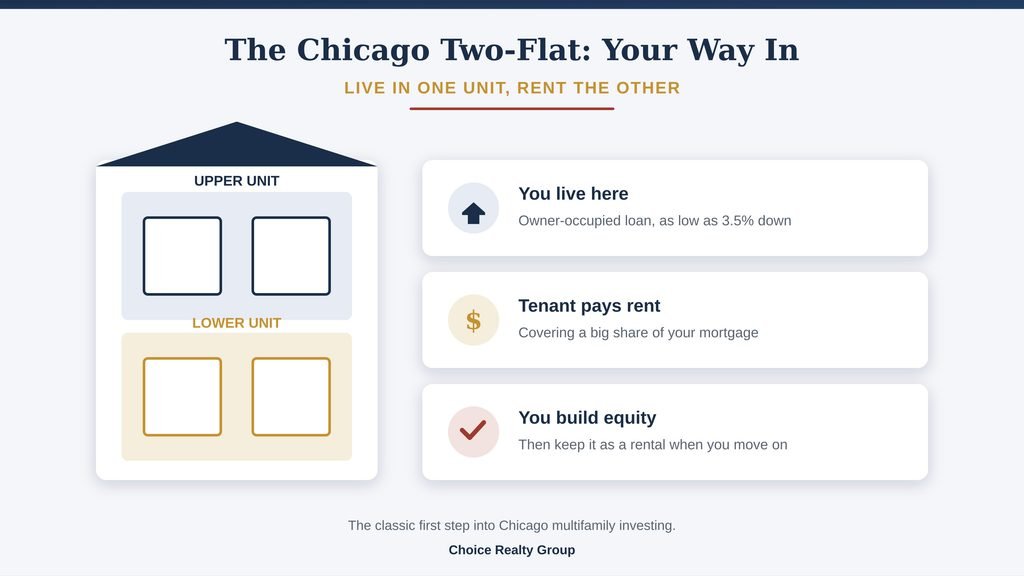
The plan is simple. Live in one unit. Rent the other. Let your tenant cover a big chunk of the mortgage while you build equity. And since a two-flat counts as residential, you can buy it with an owner-occupied loan and a small down payment. That puts it in reach for people who could never pull off a commercial purchase.
Scroll through the Chicago two flat for sale listings on any given week and you’ll see a real range. Some are move-in ready in great neighborhoods. Some need work, in areas where a little sweat equity goes a long way. One Chicago two flat for sale can honestly be the start of a portfolio you’re still growing twenty years from now.
Living in a two-flat for a few years is basically landlording with training wheels. One tenant, not ten. You learn the ropes without getting buried. Plenty of serious portfolios in this city started with exactly that building, kept as a rental after the owner moved on. So next time you drive past a Chicago two flat for sale sign, maybe slow down a little.
What Happens After You Close
Closing day feels like the finish line. It isn’t. Owning Chicago multifamily real estate is a job that really starts once you get the keys. The owners who do well treat the first ninety days like they matter, because they do.
Go through every lease. Write down when each one ends, so a renewal or a vacancy never sneaks up on you. Go introduce yourself to the tenants. Get rent collection onto something you can actually track, whether that’s an online portal or just a simple ledger.
Start a repair fund from month one. Boilers quit in January. Roofs leak in April. A building that looks great on paper can still leave you scrambling if there’s nothing set aside. A lot of owners put away a fixed amount per unit every month and don’t touch it until something breaks.
Watch your Cook County tax bill, too. A reassessment can bump up your biggest expense and quietly eat your margin. And learn the local rules on rent, deposits, and tenant rights. Getting those wrong costs way more than getting them right. Honestly, any good advice on buying multifamily property Chicago owners actually trust comes down to the same thing: plan past the purchase. It’s also where a good agent keeps paying off long after the sale.
Why Working With a Specialist Matters
Buying a multifamily building isn’t like buying a house. There’s a lot more going on.
You’re buying an income stream. You’re taking over tenants and their leases. Your loan might depend on how the building performs. And neighborhood trends can shift from one block to the next. An agent who mostly sells single-family homes is working outside their lane on a deal like this, and it usually shows. Chicago multifamily investment just has more moving parts.
That’s where a specialist comes in. Choice Realty Group has been at this for more than 33 years, focused on multifamily and investment properties across Chicago and the surrounding Illinois communities. We help investors see a deal for what it actually is, not what the listing says it is. We run the numbers with you, flag the bad leases, tell you which neighborhoods are moving, and push hard on price when it counts.
If you’re looking at opportunities in Chicago multifamily real estate, having someone local who does this every day can be the difference between a building that works for you and one that drains you for years.
Frequently Asked Questions
Is Chicago a good market for multifamily investment?
Yes, if you’re careful about what you buy. Chicago and the suburbs have strong, steady rental demand, a wide range of prices, and a ton of two- to four-unit buildings that qualify for low-down-payment loans if you live in one. But returns can swing a lot from one neighborhood to the next, so knowing the area matters more for Chicago multifamily investment than it does in most markets.
How much do I need to put down on a multifamily property?
Depends on the building and whether you’re living in it. Two to four units with you in one of them? FHA can go as low as 3.5 percent down. Five units or more is a commercial loan, usually 20 to 30 percent down, and the lender cares mostly about the building’s income.
What is the ideal cap rate in Chicago multifamily?
Not one size fits all, obviously. The higher cap rate is a sign of risk. A more conservative 5 or 6 percent cap in a well-established area, where people want to live, might be a better and safer option for the long term than 8 percent cap somewhere with actual problems. Compare similar buildings, not just pick randomly from all across the city.
Can I purchase a multifamily as my first home?
Yes, you absolutely can. Most of our customers have started off exactly that way – buying a two-to-four unit building, moving into one and renting out others. Tenants will contribute to the monthly mortgage payments, you’ll gain equity in the property and the transaction will look similar to financing of the residential property. This is one of the easiest ways to start your venture.
Why not go through an expert rather than a standard real estate agent?
Because multifamily transactions are about leases, income mathematics, Cook County tax intricacies, and financing – topics that your average home buyer does not have any experience with. An experienced broker will know how to properly assess the income, look out for the signs of problems within the documentation, and negotiate on what matters.
The Bottom Line
Multifamily real estate investments in Chicago remain one of the best ways of creating real wealth in the Midwest. But only when it is treated as a business.
The winners of the game of Chicago multifamily real estate are those people who do not try to get the lowest price for the building but rather understand the math behind it, choose the appropriate area, arrange the necessary financing, and examine the leases thoroughly before signing anything.
That’s a lot to juggle on your first deal. Or your tenth. If you’re thinking about buying multifamily property Chicago buyers are chasing right now, and you want someone who lives in this world every day, give Choice Realty Group a call. We’ll talk through what you’re after and show you the multifamily properties Chicago has on the market today.